
By Michael Stowe
Committing to the run the JFK 50 Mile meant stepping out of my comfort zone. Week after week, I built mileage, strung together back-to-back long runs, and learned to trust my body. But it wasn’t just about the miles — it was about proving to myself that I could tackle something this big at age 54.
For years, I talked about it but found reasons not to do it. A road marathon seemed more manageable. Work was busy. But the real reason was self doubt. Fear of the unknown, of failure, of falling on the Appalachian Trail and breaking another bone.
Luckily, I didn’t have to tackle it alone.
Linda not only encouraged me to take on this challenge—she supported my commitment, even as nearly every Saturday morning was spent running at Pandapas. For most of those long runs and track Tuesday workouts, I was fortunate to have great company: Scotty, Matt, Brad, Kevin, Ignacio, Brett, Andy, Thijs …
It was the most intense mileage and toughest training block I’d ever tackled—and I made it through injury-free.
But as race day approached, doubts crept in. Was I getting sick? Had I trained enough? High winds in the weather forecast didn’t help. Then, on the night before the race, one of our cats suffered a serious injury. My mind swirled with worry and doubt, but messages from friends and family helped me focus.
- “You… Are… READY!”
- “Good luck tomorrow! … You’re so fit it’ll be great. Have fun!!!
- “You are made for this. Your endurance and strength is amazing, but what’s most inspiring to me is your positivity and love of running. Let that take you through it!”
- “Let’s go Michael! Have a great JFK experience tomorrow.”
- “You can, you will, you will not be denied…’ Whatever your mantra is, you got this #JFK50k.”
After a restless night, I got out of bed at 4:30 a.m. and saw an email from Linda: “No matter what happens on the course you should take so much pride in how hard you trained! And that determination that got you through your training will get you through this race! I believe in you – believe in yourself! Have fun! You are my hero!”
I made a cup of coffee, walked outside, and saw the stars twinkling.
“You can, You will, You are strong,” I said out loud.
Facing the AT
The appeal of JFK isn’t just the 50-mile distance — it’s the variety of the course. The first 15 miles are on the Appalachian Trail, the only race in the country allowed to use the famous white-blaze path; the next 26.3 are on the flat, soft C&O Canal Trail along the Potomac River; and the last 8.4 miles are on rolling, country roads. It’s the oldest — and with more than 1,200 runners — the largest ultra marathons in the country.
My race plan was simple: start conservatively and get off the AT in one piece, fuel consistently, and log steady miles for as long as my body would cooperate. My goals: 1. Finish in under 8 hours. 2. Place in the Top 100.
I chose Brooks Catamount trail shoes for the Appalachian Trail section and — thanks to the amazing crewing of Brett Shelley and Amy Youmans — planned to change into Nike Vaporflys at mile 15. My handheld bottle and a mix of Huma and Gu gels would keep me fueled on the journey.
The race begins at 6:30 a.m., just as dawn breaks. Following Trevor’s advice, I positioned myself at the start line in the fourth row of runners —close enough to the front to avoid getting stuck in a conga line on the trails but safely behind the elites who would blaze through the course in under six hours.
The gun sounded. The jitters disappeared. It was time to do what I had trained my body to do. Run, fuel, run, fuel … repeat.
The first five miles are steady climbing with over 1,000-feet in elevation gain. At 2.5 miles, I entered the Appalachian Trail section ahead of my goal pace. I felt good and hoped it was smart to build a cushion before tackling the technical trail ahead, which I knew would be the hardest and slowest part of the course for me.
“You can, you will, you are strong,” I said.
Turns out, the AT section wasn’t as intimidating as I’d built it up to be. Sure, there were plenty of rocks—and I even took a gentle tumble at mile 7—but I found myself not just handling the challenge, but actually enjoying it.
I fell into an easy rhythm, chatting with other runners who matched my pace. We swapped race stories, and the veterans shared their many JFK experiences. Faster, more agile trail runners zipped past, but the trail was wide enough to make passing effortless. To our left, through the bare trees, the sky burned with a brilliant orange and yellow sunrise.
Surprisingly, I was clicking off miles quicker that expected — 8:05, 9:47, 10:52, 10:12 — and it felt good. I continued to get passed by runners but didn’t mind at all.
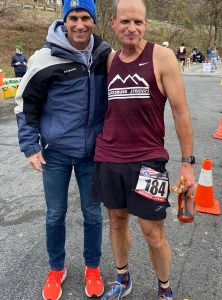
I was so impressed by the numerous first aid volunteers stationed on the remote areas of the course. I tried to thank every volunteer. This race has so much community support. So much pride. It was evident at the start line, at the aid stations, everywhere.
By the time I hit the steep switchbacks leading to Weverton, I felt relieved to have stayed upright and mostly unscathed.
There were dozens of cheering spectators in the transition area. I quickly changed my shoes, took off my long sleeve shirt, grabbed a few gels, and filled my bottle with gatorade. After a quick photo with Brett, I headed to the canal trail. I hit the tow path at 2:38:14 in 152th place.
Enduring the C&O marathon
Wearing the Vaporflys and running on a soft smooth surface felt weird at first but I settled into a rhythm — 8:29, 8:20, 8:24. The task ahead felt daunting … I still had so far to go. The canal section is almost exactly a full marathon.
“You can, you will, you are strong.”
I grouped the miles into sets of 5. Make it mile 20. Make it to the next aid station.
“You can, you will, you are strong.”
There wasn’t a lot of talking with other runners on this section. Just encouragement as we passed each other. “You got this.” “You are doing awesome.”
I walked through every aid station. So much good food: grilled cheese sandwiches, pierogis, PB&J, soup, homemade cookies. It all looked amazing. I ate none of it. My stomach was holding up well, and I wasn’t about to risk that by experimenting.
Instead, I stuck to my plan: gel after gel after gel. I started the race taking one every 30 minutes, with every third gel spiked with caffeine. As the miles wore on and my stomach continued to cooperate, I remembered something Scotty said on a training run:
“Endurance events longer than five hours are basically an eating contest.”
At mile 35 —uncharted territory for me—I stopped waiting half an hour between gels and started taking them every two miles, about 17 minutes apart. I knew I’d run out before the finish, but I’d noticed earlier that most aid stations had a supply.
And for the later miles, I had a secret weapon on my mind: Coke.
I don’t drink soda. Ever. Except when I run an ultra. Even then, it’s a tactical decision, saved for the final stretch when I need every bit of help I can get. Too much might upset my stomach, but just a few swigs? Pure rocket fuel.
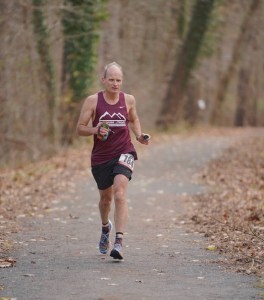
I kept clicking off miles—8:17, 8:28, 8:11—steadily passing other runners. My pace was well ahead of what I needed to break 8 hours. The low-risk move was to stay the course.
But another thought crept in: I might be able to finish under 7 hours and 30 minutes? It was an arbitrary goal, but it gave me something to chase.
I thought about something Butch had said after his massive effort and Top 5 finish at the Run Rabbit Run 100 earlier this fall: I didn’t do all that training and travel across the country to run conservatively. He’d pushed the pace and went for the podium. Maybe it was my turn to take a chance.
“You can, you will, you are strong.”
I reached mile 41.8, the end of the canal trail section, at 6:18:46 on the race clock, now in 79th place. At the final aid station on the canal, I asked a volunteer for a gel. He didn’t have one, but he did have Coke in one hand and pickle juice in the other. I took a shot of both and kept moving.
Battling headwinds to the finish
Trevor, who ran JFK in 2018, had warned me about the steep climb that comes as you leave the towpath. Up ahead, I spotted three runners, all walking. Should I try to run? How would my legs handle climbing after so many flat miles?
Surprisingly, they responded well, almost as if my muscles welcomed the change. I climbed steadily, passing one runner, then another. Reaching the top felt good—until I met the headwind. It was fierce, blowing directly into my face and stealing any sense of relief.
“You can, you will, you are strong,” I said.
In spite of the wind, I was speeding up when most other runners were slowing. I felt strong — but knew 6 miles was still a long way to go.
As I passed runners, I encouraged them to tuck in behind and let me block the wind. I kept hoping for a turn on the course that would put this wind at our backs.
Mile 44: 8:02 and a swig of soda at the aid station. Mile 46: 8:06 and more Coke. Mile 48: 8:09 and one last fizzy swallow.
I was getting close. Around mile 48.5 the course crosses a set of low railroad tracks. On a normal run, it’s not even a noticeable obstacle. On this day, it meant slight change in cadence and when my foot hit the ground I felt my left adductor start to seize into a cramp.
Uh, oh. My instinct was to slow down or even walk to control the spasm. But I know from experience the opposite sometimes happens: walking can make it worse.
I remembered Jordan’s advice: Adjust your stride slightly. Instead of slowing, I increased my cadence, sped up and gently shook my leg. Six steps later the muscle released.
With a half-mile to go, the course turned, the fierce wind finally at my back. I could hear the announcer calling out the names of runners.
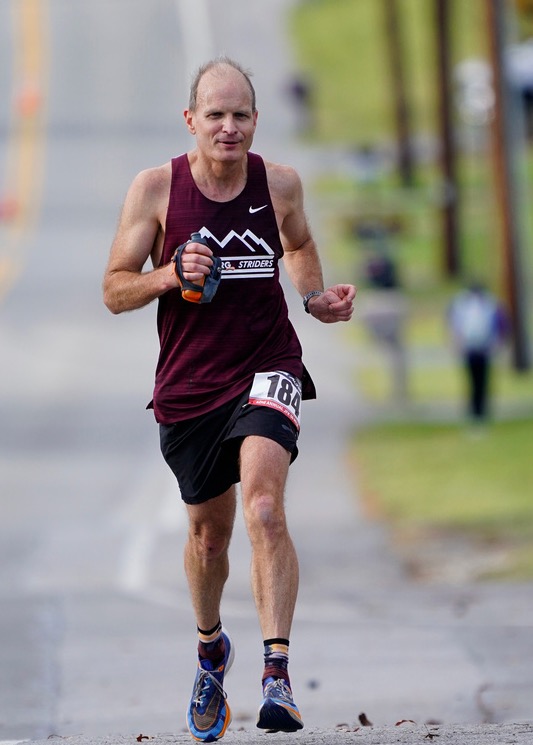
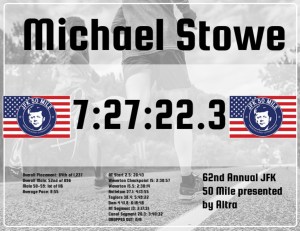
“That’s Michael Stowe from Blacksburg, VA. A first time finisher who is 54 years old, making him the oldest runner to finish so far today,” he said as I crossed the line in 7:27:22, arms raised in excitement,
I was thrilled to be done — to have accomplished such a big goal — but I think my immediate feeling was relief.
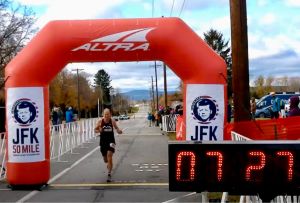
I learnedI had finished 64th overall and 1st out of 151 runners in the 50-59 age group.
I was greeted with congratulatory texts when I turned on my phone … so many people had been following along. The messages from Linda, Emma, Scotty, Matt, Brad, Brett. John and many others reminded me how lucky I am.
I was racing by myself for most of the day — but I was never alone. I’m grateful.
Gear
- Brooks Sherpa 7-inch shorts (lots of pockets),
- Nike Blacksburg Striders singlet, Swiftwick socks,
- Brooks Catamount 3 trail shoes (first 15 miles)
- Nike Vaporfly 2 shoes (final 35 miles)
- Long-sleeve (non-cotton) t-shirt.
- Thin cotton Dollar Store gloves.
- 12-ounce Nathan handheld bottle
Nutrition
- 9 Huma Gels without caffeine
- 3 Gu Roctane Gels without caffeine
- 4 Gu Roctane Gels with caffeine
- Coke (4 ounces x 4 aid station = 16 ounces)
- Pickle juice (one shot, mile 41)
You might also like this content: Butch Slabach: Trail triumphs fueled by community support, training focus
 NRV Runs
Congratulations on such a strong performance!
I hope your cat is ok.
LikeLike